Saturday, November 21, 2020

Why you shouldn't own an exotic pet!

Have you ever wondered what it would be like owning a tiger or a monkey? It would be interesting, that's for sure. But it is also extremely unethical. You see, these animals are recognized as exotic pets when privately owned. And an exotic pet is a rare or unusual pet that generally lives in the wild. For example, a chimpanzee, leopard, sloth, skunk, and squirrel are all exotic animals that should not be kept as a domesticated animal like a cat or dog would be. Today I will talk about the three reasons you shouldn't purchase an exotic animal—one of them being that these animals are crucial to the environment. For example:

Squirrels plant thousands of new trees each year simply by forgetting where  they put their acorns. | Happy facts, Happy animals, Animal facts
Squirrels plant at least 100 trees a year 

Species Profile: Castor canadensis – North American Beaver » Bella Vista  Property Owners Association
Beavers help prevent floods and wildfires
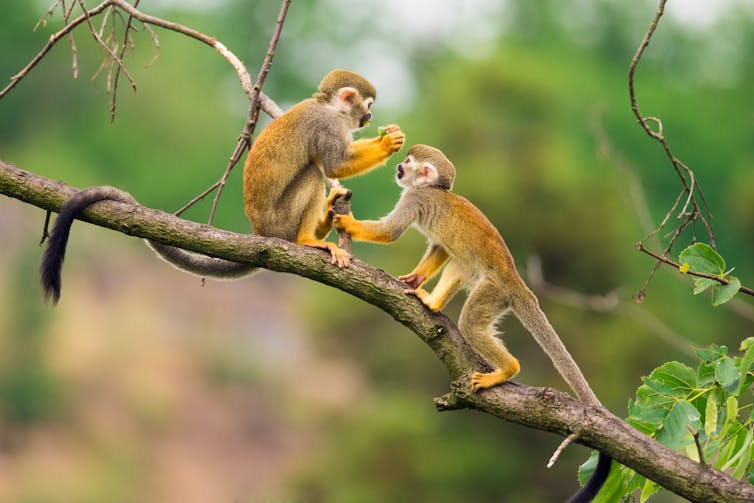
How monkeys make friends and influence each other

Monkeys help disperse seeds and fertilize the soil


—another one of these reasons being that we can't keep up with the needs these animals have. In nature, there is consistently stimulation and there are always things going on. If you look at a big parrot being kept in a cage sometimes they have patches of no feathers and bare skin. These patches are due to the parrot being bored and plucking out its feathers as a result. Isn't that awful. And if you are still considering having a big cat, know that you have to have at least 5 acres of land. At least. These animals can roam freely in the wild, so 5 acres of land is really not that much. They also need at least 15 pounds of bleeding meat every day, a health hazard for people, and at least 10,000 dollars a year. Notice how everything has an "at least" before it? That's because this is the bare minimum. Saying that you can privately keep a happy wild cat in captivity is like saying you can fly. It's an utterly unrealistic thing to say. Finally, these animals can get very dangerous and unpredictable. There are many stories of attacks on people by these pets because the animal is merely bored and frustrated. When I was younger, I remember hearing about this lady who got her face torn off by her best friend's chimpanzee. And this chimp wasn't mean spirited; it was even a therapy animal and had been in captivity it's entire life. The chimp ended up getting shot. Imagine just being so confused and so angry that you do something terrible and get shot for it. What the chimp did was not right, but it was not supposed to be kept privately in the first place. You see, I understand that it would be cool to have an exotic, uncommon animal kept in your basement, but after you think about how cruel it is, it's not as cool. So, getting an exotic animal is not a good thing to do. To support animals having free, happy lives, you simply can choose not to purchase one. It's as easy as that.


Sources: 

“Getting Started with Your Pet Bird.” The Spruce Pets, www.thesprucepets.com/bird-basics-4162100. 


“10 Fun Facts about Animals to Make You Smile.” Goodnet, 19 Nov. 2020, www.goodnet.org/articles/10-fun-facts-about-animals-to-make-you-smile. 


“What It Takes to Feed Exotic Animals.” The Columbus Dispatch, The Columbus Dispatch, 20 Oct. 2011, www.dispatch.com/article/20111020/news/310209666. 


Tuesday, May 12, 2020

Spring Flowers!

              You know it's spring when all the flowers bloom and trees turn green. Most of my favorite flowers hide in the winter, fall, and summer but pop up in the spring. Why is that? Why don't the flowers come sooner or leave later? That's what I am exploring today.

               For a plant to thrive it needs oxygen, water, light, warmth, and dirt. A plant needs water to live and not dry up, and dirt to grow it's roots and be grounded. But why light and warmth? A plant needs light to photosynthesis. Photosynthesizing is the act of a plant getting light energy and transforming it into food (Long). It sounds kind of crazy right? Transferring light to food, how do they even get the light? Well, plants absorb light into their leaves and take that light energy and change the water and carbon dioxide they already contain into glucose. They then use this glucose (a type of sugar) to repair themselves and become stronger (PBS). This is also the reason why leaves are normally green. Chlorophyll, a chemical in the plant that traps the light, is what makes plants green. Surprisingly sunlight has many different colors in it and the plant can't absorb all of them. So, the plant absorbs the red and blue light from the sun and it then reflects as the color green (PBS). You may ask, what about the fall leaves? Leaves in the fall are a range of different colors as we all have seen they can be orange, yellow, green, red, brown, etc. This is because some plants stop producing chlorophyll in the fall because there is no more light energy to trap, so the plant no longer reflects green (PBS). That already explains why plants don't bloom in fall, there is a lack of sunlight and a lack of water. The lack of water is what causes the leaves to dry up and be shed from the trees (Indianapolis children's Museum).
Leaves during Fall
            We all know that winter isn't all too sunny. This is the exact reason plants hide during wintertime. There is no light to absorb and the light in the days become much shorter. Plants live off of the food they stored in the past spring and wait the winter out (Naik).
During summer some plants thrive and some don't. This is because of the heat. Plants need warmth but to much can cause them to wilt, some plants handle it better than others and live through the summer as well as the Spring. There is also less water which also plays a role in the wilting of flowers.

            This brings us to Spring, during Spring it is just warm enough, light outside, and just the perfect amount of water (Topmarks). Plants are really picky about their living conditions and that's why Spring is the popular time to bloom. Of course there are exceptions, some plants handle different weather better than others. That's because the plants have evolved to that certain type of weather. Thanks to evolution everyone gets their pretty flowers and trees.
            An example of a Spring flower is the arrow leaf balsam root.
Arrow-leaf Balsam Root


Roses


Dahlias


Lily
(Photos taken by me)
Works Cited:
“Blog.” Why Do Leaves Fall Off Trees? | The Children's Museum of Indianapolis, Children's Museum, www.childrensmuseum.org/blog/why-do-leaves-fall-off-trees.

Long, Nicole. “The Importance of Light to a Plant.” Garden Guides, GardenGuides.com, 19 Nov. 2019, www.gardenguides.com/13404873-the-importance-of-light-to-a-plant.html.

Naik, Kavita. “Why Do Plants Need Water, Sunlight, Warmth & Soil to Grow?” Sciencing, Sciencing.com, 31 July 2019, sciencing.com/do-sunlight-warmth-soil-grow-5933400.html.

“Photosynthesis - NatureWorks.” New Hampshire PBS, PBS, nhpbs.org/natureworks/nwepphotosynthesis.htm.

“Why Do Plants Begin to Grow in Spring?” Topmarks, Topmarks.co.uk, www.topmarks.co.uk/Spring/PlantsGrowInSpring.aspx?age=ks2.

Wednesday, April 22, 2020

Earth Day! 🌎

Earth day is today! We all hear about earth day some way or another, by social media or maybe our calendars, but what is it really about? That's what I will be exploring today, the origins of Earth Day. It's pretty common knowledge that Earth day is a day where we take care of our Earth and celebrate the world we live in, but it's actually much more than that.

Earth day is a relatively modern holiday. The first Earth day was in 1970 and now over 190 countries celebrate it (various). It is April 22nd of every year because that was the day the modern environmental movement came along.  The modern environmental movement was made to target certain issues. Some issues that played a role in the birth of this movement are the oil spills of the coast of California, the endangerment of the Bald eagle, the pollution of the Great Lakes, etc. (Gordon). This was the beginning of environmentalism in the U.S. and inspired a lot of activism for our planet today. Earth day is what helped people speak up about environmental issues. According to Earthday.org, "Earth Day inspired 20 million Americans — at the time, 10% of the total population of the United States — to take to the streets, parks and auditoriums to demonstrate against the impacts of 150 years of industrial development which had left a growing legacy of serious human health impacts." In other words, Earth day gave people a voice and allowed people to share their thoughts about pollution and such. After the first Earth day the Environmental Protection Agency was created (various). The  National Environmental Education Act was then passed and so where the Occupational Safety and Health Act, the Clean Air Act, the clean water act, endangered species act, and many more (various).  These new appointed laws not only protected animals from extinction but also protected people from deadly diseases. Earth day became a big day and went global and is now celebrated in many countries. So, I encourage people to take some time today to appreciate the world we live in. Thanks for reading today's blog!
Photos to remind us of our amazing home:
Lumi Island

Methow Valley


My dog Ada

Our garden

Thailand

Iceland

Thailand

Thailand

Methow Valley


Hawaii

Crater Lake

Star flowers


Thailand

Methow Valley


(Taken by me and my mom)


Sources:
Gordon, Erin L. “History of the Modern Environmental Movement in America.” American Center, American Center, June 2012, photos.state.gov/libraries/mumbai/498320/fernandesma/June_2012_001.pdf.  Accessed 2/22/20. 

“The History of Earth Day.” Earth Day, Earthday.org, www.earthday.org/history/. Accessed 2/22/20. 

Saturday, April 18, 2020

Palm oil, soybeans, and orangutans

Palm oil, soybeans, and orangutans. I know what you're thinking, why am I talking about food and orange apes? Don't worry I have a reason. Last time I talked about how old growth Forrests should be preserved and why they matter so much to wildlife. This post is similar but about different animals.

Companies like Ritz Crackers, Nutella, Skippy, Nestle, Kraft, and many more use large amounts of palm oil in their products. Palm oil grows in rainforests and jungles where orangutans and of course many other animals live. Huge plantations have been replacing these biodiverse tropical rainforests destroying the homes of orangutans and many other species. Indonesia is responsible for 84% of the world's palm oil and harvests 33.4 million tons of it a year (various). Indonesia is also home to the now critically endangered orangutans. The UNEP estimates that an area of Indonesian rainforest the size of six football fields is cut down every minute of every day (Swink). That's crazy right? The sad part is that orangutans have emotions just like us and even share 97.8% of our DNA (Swink). Orangutans are truly amazing animals that are now soon to be extinct. It is estimated that in 20 years orangutans will be extinct (Barrett).  
Orangutans can communicate about the past just like humans, new ...


Soybeans are in soy milk, soap, tofu, and lot's of other foods.  The problem with soybeans is that they are pretty much a substitution for palm oil. This makes it so companies can say their products are palm oil free, but they still may contain soybean which isn't great either. If more soybean oil goes into products that previously used palm, that ultimately will lead to more soy plantings in Brazil’s cerrado savannah, an activity that’s indirectly linked to this year’s Amazon fires (Fickling). So how are soybeans related to the fires in the Amazon? There is a rush to plant soybeans because of the backlash of palm oil. Mainly in Brazil where most of the Amazon lies people are burning the forests down in order to make room for, you guessed it, soybean plantations. 

What can we do?

To help solve this issue you can actually do a lot! By spreading information to not buy things that contain palm oil or soybeans in them you can help save the Orangutans. Next time you go to the grocery store you can also make sure the products you are buying are not only palm free but also soy free. This way you won't fall into the trap marketers have set for people who are hoping to save the environment. There are also many petitions out there that you can sign to help stop this issue. By eliminated products like Nutella from your grocery list can really make an impact. 

Thanks for reading today's post and stay tuned for more!


Sources:
Barrett, Kenna E. “Stop Using Palm Oil in Nutella. Save the Orangutans!” Change.org, Change.org, www.change.org/p/stop-using-palm-oil-in-nutella-save-the-orangutans.

Bloomberg, David Fickling |. “Analysis | Palm Oil's Price Switch Won't Save the Orangutan.” The Washington Post, WP Company, 25 Nov. 2019, www.washingtonpost.com/business/energy/palm-oils-price-switch-wont-save-the-orangutan/2019/11/25/2f8e7b0a-0f5d-11ea-924c-b34d09bbc948_story.html.

“Endangered Species Conservation.” WWF, World Wildlife Fund, www.worldwildlife.org/.


Patricio, Miguel. “Land Grab for Soybeans Blew Up the Amazon Rainforest.” CNS, CNS, 28 Aug. 2019, www.courthousenews.com/land-grab-for-soybeans-blew-up-the-amazon-rain-forest/.

         Swink, Margaret. “What's in Your Food That's Destroying Orangutans?” Grist, Grist, 4 May
2010, grist.org/article/whats-in-your-food-thats-destroying-orangutans/.


Un. “UNEP - UN Environment Programme.” UNEP - UN Environment Programme, UNEP, www.unenvironment.org/.

Monday, April 6, 2020

old growth trees

Today I am writing about old growth trees and why they are so important. According to National Geographic, since humans started cutting down forests, 46 percent of trees have been felled. About 17 percent of the Amazonian rainforest has been destroyed over the past 50 years. Those are pretty big numbers, but why do birds even need old forests? Well an old growth forest is a forest that is at least around 120 years old. These forests have a lot of biodiversity and have been undisturbed and naturally developing for years. People have been destroying these forests to produce lumber and space, but as they do this the plants and animals become endangered and even extinct. 

According to globalforestwatch.org the Conservation of Nature (IUCN) has declared 665 species either completely extinct or extinct in the wild. That's a lot of species! Here are some examples of species that have gone extinct or endangered due to habitat destruction and loss: 
Formosan Clouded Leopard
This leopard lived in Taiwan. It went instinct in 2013 caused by the destruction of their habitat. Their homes were replaced with agriculture land and they were forced out. 
Formosan Clouded Leopard Confirmed to Be Extinct in Taiwan
Spix's Macaw
This beautiful macaw was declared extinct in 2018. There are a few left in captivity. They were traded for pets and their homes were again lost by agriculture. It is also the rarest parrot species in the world. 
Land Purchase for Spix's Macaw - Rainforest Trust Saves Rainforest
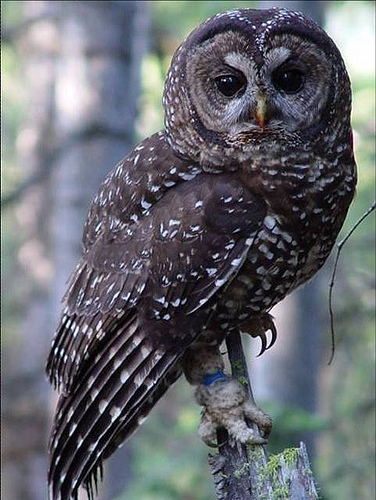
Northern Spotted owl
The Northern spotted owl's population is rapidly decreasing due to habitat loss. They are listed as threatened under the endangered species act. The habitat of these owls has been cut downs and produced into lumber. 
Giving a Hoot About the Northern Spotted Owl - American Forests
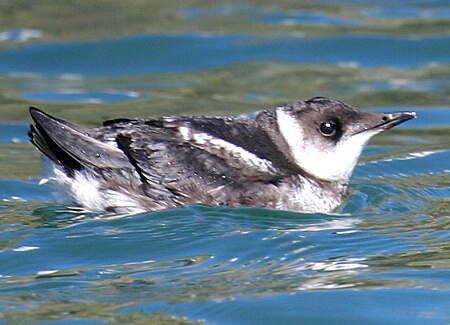
Marbled murrelet
The Marbled Murrelet is a type of sea bird that only nests in old growth forests at high elevations. Their nesting areas are now very limited due to habitat loss and their population is decreasing fast. This species is listed as threatened since 1990. 
Marbled Murrelet | American Bird Conservancy

There are many more animals that suffer from habitat loss too. If this keeps up we will not only have lost but will lose tons more animal species. Ways to help to stop deforestation and habitat fragmentation is to support the protected forests and abide by their rules such as no hunting or hiking through the forests. I encourage you to try a little experiment. If you have any old or dead trees around or in your backyard setup feeders near them. Track which trees your birds prefer the live or dead ones? For me at my cabin in Winthrop the birds were much more drawn to the older trees than any of the live new trees. The birds even perched in dead brush. I am not totally sure why but I think our birds prefer old growth more than new growth because of how sturdy and stable the branches are. I think this could be why because birds want to build a nest in a sturdy tree.. right? Have you ever hung ornaments on a tree and some branches are super flimsy and can't hold the weight of the ornament? Well I definitely have and scoping out the dead branches to hold the weight of the ornaments seemed much more effective. This hypothesis is not backed up by any evidence just by personal experience! So if you would like try this out and see what happens! Thank you! 
(The pictures are not taken by me!)


Sources: 
Siskiyou, Klamath. “Northern Spotted Owl.” Klamath-Siskiyou Wildlands Center, Klamath-Siskiyou Wildlands Center, 12 June 2017, www.kswild.org/imperiled-species-profiles/2017/6/12/northern-spotted-owl.

Cornershop. “The Endangered Species Act.” Endangered Species Coalition, www.endangered.org/endangered-species/.


Institute, World Resources. “Forest Monitoring Designed for Action: Global Forest Watch.” www.globalforestwatch.org/.

“Stories of Animals, Nature, and Culture.” National Geographic, www.nationalgeographic.com/.


Thursday, April 2, 2020

Methow Valley backyard birds


Waking up to the little chirps and songs of birds is one of the most comforting things. Each type of bird has its unique song and somehow they all just fit. During this time of quarantine, we have been staying in our cabin in the Methow Valley. It has been a time full of boredom, confusement, anxiety, the want to go see my friends, but of course, everyone is experiencing this. Instead of staring blankly at Instagram, I am deciding to post on here. I will try to update as much as possible to cure my boredom and hopefully some of yours.

Today's blog will be about my backyard birds. A backyard bird is exactly what it sounds like, a bird in your backyard. We have set up 4 bird feeders around our property. There have been many visitors including tons of Stellar jays and Dark-eyed juncos, woodpeckers, nuthatches, a Spotted Towhee, and many more. As we go on hikes we also see grouse, ravens, eagles, hawks, and Wild turkeys. The birds that stood out to me the past two weeks have been a Williamson sapsucker, white-headed woodpecker, Northern goshawk, and the Dusky Grouse. The Williamson Sapsucker was a new bird for me, it has a little yellow belly and is adorable. The White-headed woodpecker is a little woodpecker with obviously, a white-head. We used to have a white-headed woodpecker nest in the sign leading up to our neighborhood. Sadly, someone ran into that sign and they lost their home:(. The Northern Goshawk I didn't think much about. I was outside and getting ready for school, it was so early I thought I just saw a gigantic seagull perched in a tree. Later my stepdad said it was a Northern Goshawk which is also a new bird for me. I definitely feel a little stupid but hey, it was early and I hadn't gotten my Chai tea latte yet. Lastly, the grouse, I have always loved grouse for some reason. When I was little I was obsessed with them. The male grouse's display is just so cool!

A close up of a Dark-eyed Junco

We have a little hot tub and I have been sitting in it watching all the birds. They all are like their own little community. They usually get along but an occasional argument comes up typically it's over food. I really could watch the birds for hours, the ways they communicate with each other are so cute and fun to watch. Once a raven flew over and all the birds warned each other. A couple of them started mobbing the raven too. I really encourage everyone to put up feeders. Watching the birds is a great way to spend your time locked up at home.
The occasional argument between two Juncos
A Red-breasted nuthatch
Northern goshawk
Williamson sapsucker, isn't the yellow belly so pretty!

Wednesday, January 16, 2019

Elephant Encounters In Thailand

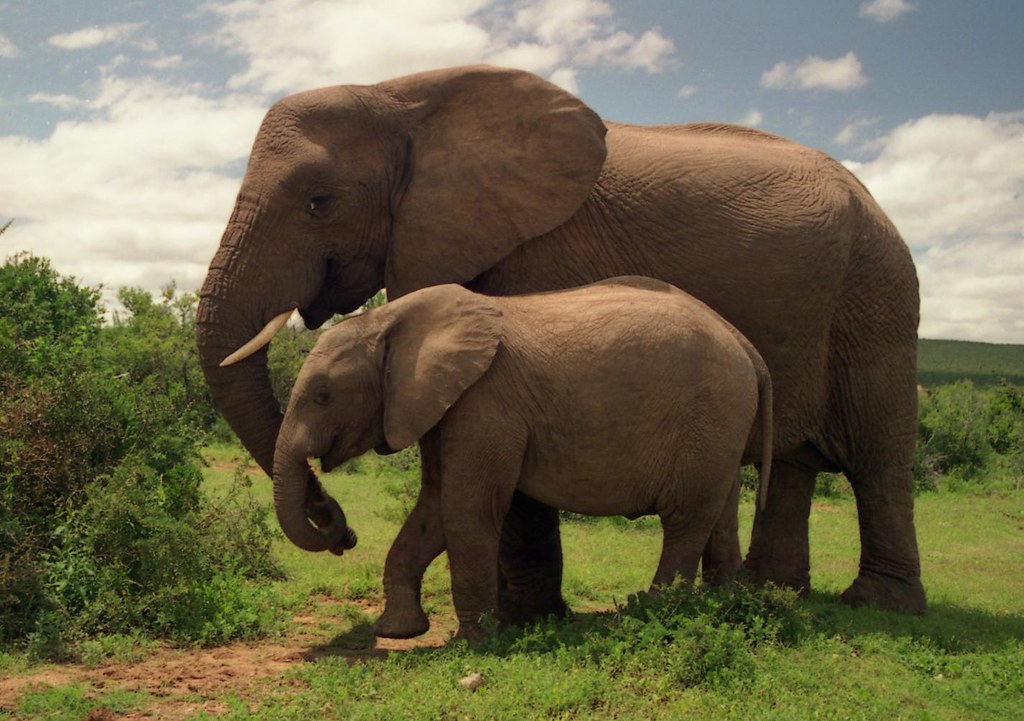
We will be going to Thailand for 17 days this Spring. I am super excited! We have been planning our trip and we came across elephant orphanages where you can go see, pet, bathe, and feed the elephants. These elephants are treated well and in their natural habitat.

Related image

One orphanage we came across even lets you ride them! Sounds great right?! Well, actually elephants unlike horses are not naturally able to be ridden. What many organizations do to their elephants is actually horrifying. They will take the babies away from the mothers at a young age and start the "training". The baby elephants are trained at a very young age and are beaten when they mess up. The "trainer" uses things like bullhooks or other cruel instruments. This not only hurts the spirit of the young animal but causes them to do obey the trainer to avoid being beaten. 


Image result for baby thai elephants


The elephants also don't live a natural life walking miles upon miles a day. They are kept in sheds with concrete floors, the legs of the elephant are also chained down so they can barely move. These hard floors damage the elephants legs. Aside from that the food they are given lacks nutrients that wild elephants eat on a regular basis.

Image result for elephants chained down
  

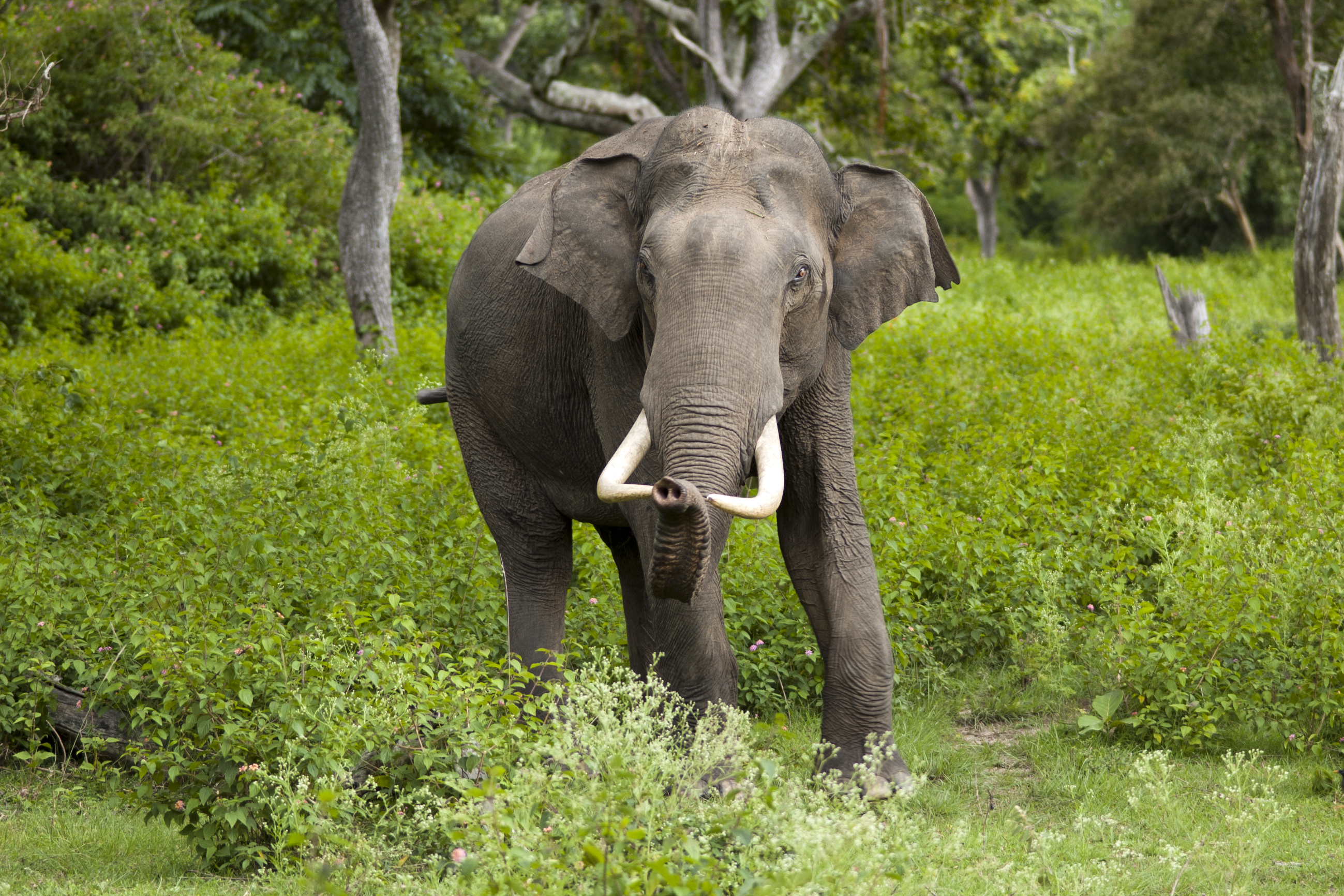
Asian elephants weigh on average 12,000 lbs, but unlike some animals they are not used to having weight on their backs. The weight of even just one person can cause pain to the elephant and even serious injuries to their spine. This is one thing that many people take for granted, which is understandable because of the elephants massive size. Although elephants seem tough and big, which they are, it is still not good to ride them. The cruelty that goes into training them to be ridden is not respectable. There are sanctuaries that do take care of the elephants though and put them in a natural environment.


Image result for elephants


Although it would be easy to ride the elephants in Thailand, it is very important to be a mindful traveler when you explore different places. If I hadn't done this research I suspect I would have had regrets.

Ethical sanctuaries:
-https://elephantjunglesanctuary.com/about-us/
-https://www.elephantnaturepark.org/
-http://bees-elesanctuary.org/